
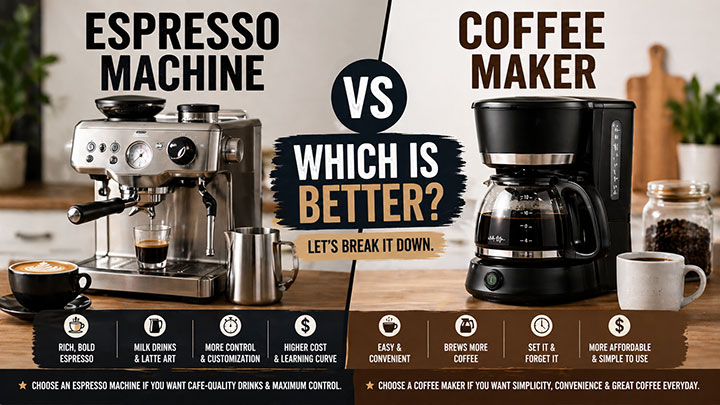
If you’re standing in front of your kitchen counter wondering whether to buy an espresso machine vs a coffee maker, you’re not alone. In 2026, more home buyers than ever are asking this question, especially as small‑batch specialty coffee and “café‑style” drinks at home have become the norm.
The main pain points are simple: budget, time, space, and how strong or mild you want your coffee. Do you want quick, easy cups for the whole family, or are you chasing rich, creamy espresso and milk‑based drinks that feel like a real cafetiere experience? This comparison will cut through the hype, break down the real‑world differences, and wrap up with a clear verdict in 2026.
Side‑by‑Side Comparison Table
Here is a feature‑focused comparison between a typical entry‑to‑mid‑range espresso machine (e.g., De’Longhi Dedica‑class) and a standard drip coffee maker (e.g., 12‑cup programmable brewer). All prices are in US dollars and reflect current mid‑2026 retail ranges.
| Feature | Espresso Machine | Coffee Maker | Winner |
|---|---|---|---|
| Price (entry‑mid) | $250–$500 for a solid semi‑automatic or compact machine | $40–$150 for most 10–12‑cup drip models | Coffee Maker |
| Build quality | Die‑cast metal or high‑grade plastic, stainless steel portafilter, solid pump system | Mostly plastic housing with glass or thermal carafe | Espresso Machine |
| Performance (brew) | 9–15‑bar pressure, 25–30 sec per shot, strong crema, rich body | 4–10 min full‑pot drip, lighter body, simple extraction | Espresso Machine |
| Brew time per serving | 25–40 sec per 1–2 oz shot (plus milk‑steaming time if needed) | 4–10 min for 10–12 cups but ready in bulk | Espresso Machine (per serving) |
| Water tank capacity | 1–2 L on most home units | 1–1.8 L on standard drip models | Tie |
| Usability & learning | Moderate learning curve: grind, dose, tamp, steam‑milk if desired | Set timer, add water and grounds, push “brew” | Coffee Maker |
| Milk frothing | Built‑in steamer or automatic frother on most dedicated machines | None on most drip models; add‑on frothers extra | Espresso Machine |
| Customization | Grind size, dose, shot time, temperature (on better models) | Fewer options; mainly brew strength switches or small beans vs pre‑ground | Espresso Machine |
| Maintenance | Daily wipe, weekly cleaning, monthly descaling, backflushing on some models | Rinse carafe and basket, occasional descaling only | Coffee Maker |
| Counter space | Wider footprint, often taller, needs steam area and portafilter space | Tall and narrow, easy to fit under cabinets | Coffee Maker |
| Value for money | Higher upfront cost but unlocks espresso, lattes, cappuccinos, etc. | Low cost, great for large batches; cheaper to keep running | Coffee Maker (for budget) |
Detailed Review of Espresso Machine
An espresso machine is built for people who want barista‑style drinks at home: short, intense shots of coffee topped with creamy crema, and the ability to make lattes, cappuccinos, and americanos. In 2026, entry‑level semi‑automatic models like the De’Longhi Dedica‑class or similar units give you a 9–15‑bar pump, a stainless steel portafilter, and a steam wand for milk texturing, all packed into a compact countertop design.
These machines usually heat up in 15–30 seconds and can pull a 1–2 oz shot in roughly 25–30 seconds once warmed, which compares very favorably with the 4–10‑minute cycle of a drip‑style coffee maker.
In real‑world use, an espresso machine shines if you or a household member enjoy strong, concentrated coffee or milk‑based drinks. You can adjust grind size, dose, and shot length to fine‑tune flavor, and higher‑end home units often include temperature control for more consistent results. he built‑in steam wand lets you froth and heat milk for lattes or cappuccinos, turning a simple machine into a small home café. On the downside, it’s less convenient for making a full pot for several people at once, and you’ll need to clean the group head, portafilter, and steam wand regularly to keep the machine working well.
Pros
- Produces rich, concentrated espresso with a good layer of crema.
- Enables lattes, cappuccinos, macchiatos, and other milk‑based drinks with a single machine.
- Faster per‑serving brew time than waiting for a full drip pot.
- More control over flavor through grind, dose, and shot‑time adjustments.
- Higher‑end models offer better build quality and more durable components.
Cons
- Higher upfront cost compared with most drip coffee makers.
- Steeper learning curve for beginners (tamping, milk frothing, dialing in grind).
- Requires more frequent cleaning and periodic descaling or backflushing.
- Takes up more counter space and may need extra accessories like a grinder.
- Not ideal if you mainly want cheap, easy coffee for several people at once.
Detailed Review of Coffee Maker
A coffee maker (meaning a standard drip or programmable brewer) is the classic choice for households that prioritize simplicity, convenience, and low cost. In 2026, most 10–12‑cup models sit comfortably in the $40–$150 range and let you set a timer, fill the reservoir, add ground coffee, and press “brew” for a full pot ready in 4–10 minutes. These machines are widely available in both glass‑carafe and thermal‑carafe versions, with washable or paper filters and optional brew‑strength settings. They’re the go‑to for families, offices, or anyone who wants a hot pot of coffee that lasts for several hours without needing extra training or fuss.
In daily use, the coffee maker wins on “set‑and‑forget” convenience and low maintenance. You don’t need to tamp coffee, adjust pump pressure, or steam milk; you simply keep the water tank filled and the grounds in the basket. Most units are easy to clean (rinse carafe and basket, occasional descaling), and they take up relatively narrow vertical space, making them good for tighter kitchens. On the flip side, drip coffee is generally lighter and milder than espresso, with less crema and no built‑in milk frothing unless you buy a separate frother. Also, once the pot is done, you’re stuck with that batch until the next brew, which can mean cooling or reheating if you’re a slower drinker.
Pros
- Very low upfront cost for most 10–12‑cup drip models.
- Extremely simple to use: add water, add grounds, press brew.
- Great for making large batches for several people at once.
- Minimal maintenance: just occasional rinsing and descaling.
- Compact vertical design fits easily under most cabinets.
Cons
- Produces milder, less concentrated coffee with no crema.
- Very limited control over extraction and flavor versus an espresso setup.
- No built‑in milk frothing; lattes or cappuccinos require extra tools.
- Longer cycle time when you only want one or two cups.
- Fewer “premium” bells and whistles compared with modern espresso machines.
Final Verdict & Winner Declaration
If you’re looking at espresso machine vs coffee maker in 2026 and want a single winner for most English‑style buyers, the coffee maker is the clearer choice for value, ease of use, and everyday convenience.
It scores higher on price, simplicity, and maintenance, and it’s better suited to families or anyone who wants a no‑frills, low‑effort way to keep a full pot of coffee on hand. The lower learning curve and minimal upkeep make it a safer bet for casual coffee drinkers and busy households.
That said, the espresso machine wins for drink quality, versatility, and café‑style experience, especially if you love strong espresso, lattes, or cappuccinos and don’t mind spending more upfront and putting in a bit of effort. It’s the better pick if you treat coffee as a craft project and want to experiment with grind, dose, and milk‑steaming.
Overall, the coffee maker is the best “all‑round” buy in 2026, while the espresso machine is the better choice for enthusiasts who care more about flavor and style than pure cost savings.