
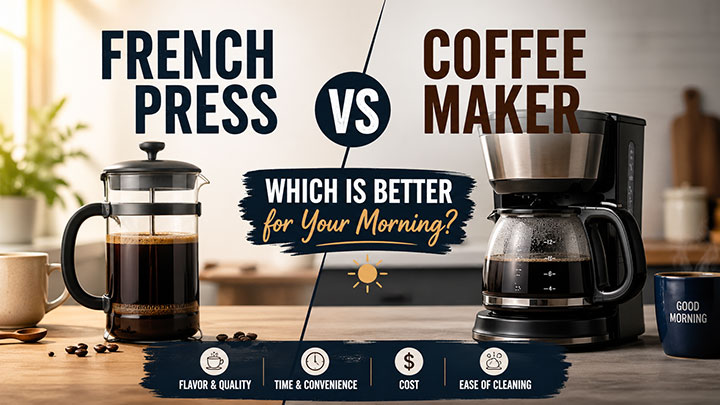
If you’ve ever stared at your kitchen counter wondering whether a French press vs coffee maker will give you the better cup of coffee, you’re not alone. In 2026, more home‑brewers than ever are comparing these two classics, especially as people pay more attention to how their coffee tastes, how easy it is to use, and how much cleanup it leaves behind.
Common pain points include messy filters, weak‑tasting drip coffee, or the hassle of steaming milk and complicated machines. This side‑by‑side will cut through the noise, show you how each one works day‑to‑day, and end with a clear verdict on which is better for most English‑style households in 2026.
Side‑by‑Side Comparison Table
Below is a feature‑focused French press vs coffee maker comparison that lines up a typical 34‑oz French press (e.g., Bodum‑style) with a standard 12‑cup drip coffee maker (e.g., Mr. Coffee or similar). Prices are in US dollars and reflect current mid‑2026 retail ranges.
| Feature | French Press (34‑oz glass) | Coffee Maker (12‑cup drip) | Winner |
|---|---|---|---|
| Price (entry‑level) | $20–$35 for a basic glass model | $30–$70 for most 12‑cup drip units | French Press |
| Build quality | Glass carafe, stainless filter, plastic or metal frame; simple but fragile | Mostly plastic body, glass carafe plus warming plate; sturdy and mass‑produced | Coffee Maker |
| Performance (brew) | Full‑immersion brewing, rich, bold, full‑bodied flavor with noticeable oils | Gravity drip, milder, cleaner‑tasting coffee with less body | French Press (for flavor intensity) |
| Brew time | 4–5 minutes after adding water, plus waiting for boiling water | 6–10 minutes for a full 12‑cup pot once started | French Press (actual brew time) |
| Ease of use (daily) | Boil water, add grounds, stir, steep 4 minutes, press down, pour | Add water, add grounds, press brew, wait; some have programmable timers | Coffee Maker |
| Customization | Adjust grind, dose, and steep time for stronger or smoother cups | Limited options; maybe a “bold” or “strong” button on some models | French Press |
| Cleaning & maintenance | Disassemble plunger, rinse carafe and filter; more pieces to hand‑wash | Rinse carafe and basket; occasional descaling only on many models | Coffee Maker |
| Capacity per batch | Around 3–4 strong cups from a 34‑oz French press | Up to 12 milder cups from a 12‑cup drip machine | Coffee Maker (for volume) |
| Portability | Lightweight, no wires; great for travel, camping, small homes | Needs an outlet and counter space; less mobile | French Press |
| Counter space | Compact footprint, but you need a kettle and space to work | Vertical design, easy to fit under cabinets | Coffee Maker |
| Value for money | Extremely cheap upfront, great for flavor‑focused drinkers | Low to mid‑range cost, better for convenience and large‑batch brewing | French Press (if you want rich flavor) |
Detailed Review of French Press
A French press is a simple, no‑electric kettle‑style brewer that gives you a rich, full‑bodied cup of coffee in just a few minutes. It usually consists of a glass or insulated carafe, a metal lid, and a plunger with a fine‑mesh filter. You boil water, add coarsely ground coffee to the carafe, pour the water, stir once, let it steep for about 4 minutes, then press the plunger down and pour. The coffee you get is noticeably heavier and more intense than most basic drip machines, with a thick layer of oils and a bold mouthfeel.
In real‑world daily use, the French press is great for people who enjoy strong, straight‑forward coffee and don’t mind a slightly more hands‑on routine. It’s easy to take on trips or use in small kitchens where you don’t want to clutter the counter with another electric appliance. You can also reuse filters and avoid paper‑waste, which is a plus for eco‑conscious drinkers. Because the brew is controlled by grind size, dose, and steep time, it’s easy to tweak towards a smoother or more intense cup depending on your mood. On the downside, French presses need regular hand‑washing, and the glass versions can crack if dropped or overheated.
Pros
- Rich, bold, full‑bodied coffee with more oils and body than drip machines.
- Simple, no‑electric design that works anywhere with hot water.
- Very low upfront cost; one of the cheapest ways to upgrade flavor.
- Easy to clean and maintain, with reusable metal filter.
- Portable and compact, good for small homes, travel, or camping.
Cons
- Requires boiling water and a bit more manual effort each morning.
- Glass carafes can be fragile; insulated models are pricier.
- More hands‑on steps (measure, wait, press, clean) vs push‑button automation.
- Limited capacity; not ideal if you need a big pot for several people.
- Can leave small grounds in the cup if the filter mesh isn’t fine enough.
Detailed Review of Coffee Maker
A coffee maker, in this context, means a standard 12‑cup drip coffee maker that plugs into the wall and uses a paper or reusable filter. These machines are the classic choice for households that want a simple, automatic way to make a full pot of coffee each morning. You fill the reservoir with water, add ground coffee to the basket, press “brew,” and in about 6–10 minutes your carafe is full. Many models include a programmable timer so your coffee starts brewing before you wake up, and most have a warming plate to keep the pot drinkable for a while.
For everyday English‑style homes, the drip coffee maker is hard to beat for convenience and reliability. It’s ideal if you share coffee with a partner, family, or roommates and want a hot pot ready without thinking much about it. The coffee is usually milder and cleaner‑tasting than French press, which many casual drinkers prefer, especially if they’re used to filters or paper‑pod systems. Some premium drip models offer “bold” or “strong” settings and better temperature control, but most basic 12‑cup units keep things simple and inexpensive.
Pros
- Very easy “set‑and‑forget” use each morning.
- Brews 10–12 cups quickly, perfect for households and guests.
- Low to mid‑range price for most reliable models.
- Simple maintenance: rinse carafe and basket, occasional descaling.
- Compact vertical design that fits under most cabinets.
Cons
- Coffee is generally milder and less rich than French press.
- Limited control over flavor beyond basic strength settings.
- Needs electricity and counter space, which limits portability.
- Some models overheat or keep coffee on a hot plate too long, drying out flavor.
- Paper filters add recurring cost and waste unless you use a reusable filter.
Final Verdict & Winner Declaration
When you stack French press vs coffee maker in 2026, the coffee maker is the clearer winner, especially if you value convenience, large‑batch brewing, and low daily effort. It makes it easy to brew a full pot while you get ready in the morning, suits families or roommates, and requires almost no extra steps once you’ve set it up. That “push‑button” simplicity is exactly why drip coffee makers dominate households where speed and routine matter more than flavor nuance.
However, the French press wins for flavor‑focused drinkers who want a richer, bolder cup and don’t mind a slightly more hands‑on routine. It’s one of the best‑value ways to upgrade your coffee without spending much, and it’s very portable for travel or small kitchens.
Overall, if you want one clear WINNER for most people in 2026, it’s the coffee maker, with the French press as a strong second‑choice for solo drinkers, coffee‑lovers, or anyone who prefers a stronger, more intense cup and doesn’t mind a few extra steps.