
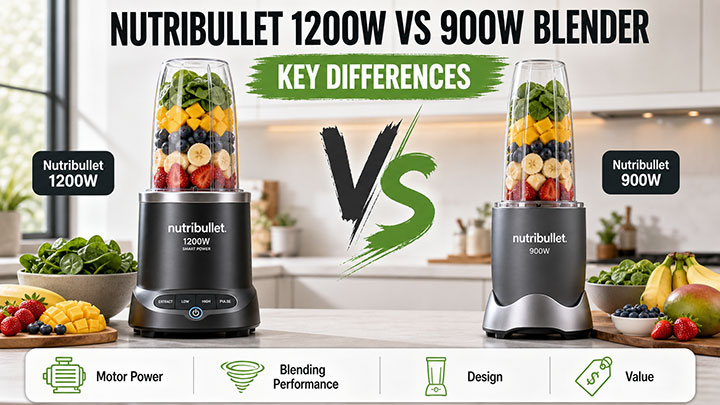
If you’re trying to decide between the nutribullet 1200W vs 900W blender, you’re facing one of the most common “up‑or‑not” choices in the personal‑blender world. Both machines promise smoothies, shakes, and nutrient‑rich drinks, but the 1200W model adds more power and versatility.
Common pain points include not knowing whether the extra wattage really changes the texture, worrying about clutter, and wondering which one offers the best long‑term value.
This comparison will break down the real‑world differences, highlight where each machine shines, and help you answer the question: which is better for your kitchen and your lifestyle? By the end, you’ll have a clear favorite for smoothies, proteins, and everyday blending.
Side‑by‑side comparison table
| Feature | Nutribullet 1200W Blender | Nutribullet 900W Blender | Winner |
|---|---|---|---|
| Price (US street, 2026) | Around $110–$140 (often on sale near $110–$120) | Around $70–$90, frequently discounted under $80 | Nutribullet 900W (better value) |
| Motor power | 1200W full‑size motor or personal‑style 1200W base | 900W personal‑blender motor, ~24,000 RPM | Nutribullet 1200W (more powerful) |
| Build quality & materials | Sturdy plastic base, stainless‑steel extractor blade, BPA‑free pitcher and cups; often feels more premium | Same high‑quality plastics, stainless‑steel blade, but slightly lighter base | Nutribullet 1200W (slightly more robust) |
| Smoothie performance (frozen fruit, greens, ice) | Handles very thick mixes, kale, seeds, and frozen fruit with minimal effort; smoother overall texture | Strong for everyday smoothies, but can struggle with very dense or fibrous blends | Nutribullet 1200W (better blend) |
| Controls | Full‑size model with multiple speeds + pulse; some 1200W combos add a 60‑second auto‑cycle | Simple twist‑on base; one‑speed on/off blending, no presets | Nutribullet 1200W (more control) |
| Capacity | 64‑oz pitcher plus 24 oz and 32 oz cups (combo sets) or large personal‑style jars | 24 oz and 32 oz cups only; personal‑sized servings | Nutribullet 1200W (more volume) |
| Extra uses (soup, nut butter, sauces) | Can handle hot soups, nut butters, sauces, and dough thanks to higher power and pitcher design | Mostly smoothies and light sauces; limited on heavy nut butters or soups | Nutribullet 1200W (more versatile) |
| Cleanup | Cups and pitcher are dishwasher‑safe; blades are twist‑on and easy to rinse | Cups and lids dishwasher‑safe; extractor blade must be hand‑washed | Nutribullet 1200W (slightly easier) |
| Noise level | Strong motor, but full‑size design and lower‑frequency engineering can make it feel smoother, if not quieter | Noticeably loud personal‑blender whine; 600W range sound level | Nutribullet 1200W (slightly more muted) |
| Warranty & durability | Standard limited warranty (around 1 year), but built for more heavy‑use tasks | Same 1‑year‑style warranty; durable for light‑to‑moderate use | Nutribullet 1200W (built tougher) |
| Portability (small kitchens, travel) | Larger base and pitcher; needs more counter and storage space | Compact, lightweight base; easy to store in small kitchens | Nutribullet 900W (more portable) |
| Value for money | Higher price, but you pay for more power, capacity, and versatility | Lower price with solid performance for basic smoothies and shakes | Nutribullet 900W (best budget value) |
Detailed review of Nutribullet 1200W Blender
What the Nutribullet 1200W Blender is
The Nutribullet 1200W Blender is a step up from Nutribullet’s personal‑style blenders, designed for people who want more power and capacity without leaving the Nutribullet ecosystem.
It comes in two main forms: a 1200‑watt full‑size blender with a 64‑oz pitcher, multiple speeds, pulse function, and sometimes a vented lid for hot ingredients, and a 1200‑watt personal‑style “Ultra” or “Pro 1200” that keeps the twist‑on‑cup design but adds more power and often touchscreen‑style controls.
In both versions, the 1200W motor spins at high speeds, creating a strong vortex that pulls ingredients into the stainless‑steel extractor blade for a smoother, more consistent blend.
Real‑world usage and performance
In real‑life use, the Nutribullet 1200W Blender feels like a “serious” kitchen machine rather than just a smoothie gadget. It handles thick smoothie bowls, frozen fruit, ice, seeds, and fibrous greens like kale with noticeably less effort than the 900W model.
The 1200W full‑size combo set, for example, includes a 64‑oz pitcher, a tamper, and multiple cups, so you can blend for one person or a small family without needing multiple devices.
Multiple speeds and a pulse mode let you fine‑tune texture: start low and build up for an extra‑smooth smoothie, or use pulse to keep some texture for a smoothie bowl or salsa. Some 1200W designs (like the Ultra) add a 60‑second auto‑cycle, so you can walk away and still get a consistent blend. The 1200W motor is also strong enough for tasks beyond smoothies, including hot soups, nut butters, sauces, and even small batches of dough.
Pros
- 1200‑watt motor delivers noticeably stronger performance for thick smoothies, ice, and fibrous greens.
- More capacity with a 64‑oz pitcher or larger personal jar, ideal for multiple servings or batch‑blending.
- Multiple speeds + pulse give you more control over texture than the twist‑on‑only 900W.
- Can handle soups, nut butters, sauces, and dough, making it a true all‑round kitchen blender.
- Cups and pitcher are dishwasher‑safe, simplifying daily cleanup.
Cons
- Higher price tag, with most 1200W models selling around $110–$140.
- Larger footprint and heavier base, which can be an issue in small kitchens or tiny apartments.
- Still limited warranty (about 1 year), so you’re paying more upfront but not necessarily more long‑term protection.
If you want a more powerful machine that can handle everything from smoothies to soups and nut butters, the Nutribullet 1200W Blender is a strong, versatile option.
Detailed review of Nutribullet 900W Blender
What the Nutribullet 900W Blender is
The Nutribullet 900W Blender is the middle‑tier personal blender in Nutribullet’s lineup, sitting between the 600W original and the 1200W models. It runs on a 900‑watt motor that spins at about 24,000 RPM, giving it enough power to crush frozen fruit, leafy greens, and protein powder into smooth drinks. The standard set includes a 24‑oz and 32‑oz cup, to‑go lids, sealing rings, and a stainless‑steel extractor blade, so you can blend, drink, and take your smoothie on the go without extra dishes.
Real‑world usage and performance
In everyday use, the Nutribullet 900W Blender is great for quick smoothies, protein shakes, and light green drinks. It handles bananas, berries, yogurt, and milk or plant‑based alternatives very well, producing a smooth, drinkable texture under normal conditions.
When you add ice, frozen fruit, or thicker nut‑butter mixes, the 900W motor can manage them, but it may require a bit more liquid or longer blending time to avoid stalling or overheating.
The twist‑on base is simple: you push the cup onto the motor, twist it locked, and blend by holding the handle. There are no speed settings or presets, which makes it easy to learn but also limits your control over texture. This simplicity is great if you want a “set it and forget it” style of blending, but it can feel limiting if you want to experiment with different textures.
Pros
- 900‑watt motor is strong enough for most everyday smoothies and protein shakes.
- Compact, lightweight base that fits small kitchens and crowded countertops.
- 24 oz and 32 oz cups plus to‑go lids make it easy to blend and drink on the go.
- Dishwasher‑safe cups and lids simplify cleaning.
- Lower price than the 1200W model, often under $80–$90 on major retailers.
Cons
- One‑speed blending; no speed or preset options, so you must manually time each blend.
- Can struggle with very thick or fibrous blends if you don’t add enough liquid.
- Smaller capacity; best for 1–2 personal servings, not family‑style batch‑blending.
For someone who wants a budget‑friendly, compact blender for daily smoothies and shakes, the Nutribullet 900W Blender is a solid choice. It’s not as powerful or versatile as the 1200W, but it covers the basics very well.
Final verdict & winner declaration
When you compare the nutribullet 1200W vs 900W blender, the clear winner for most people is the Nutribullet 1200W Blender. It offers significantly more power, smoother blends, and better handling of thick, fibrous, or frozen ingredients, while also giving you more capacity and versatility for tasks beyond smoothies.
The nutribullet 1200W blender wins because it provides better performance in real‑world use without asking you to change your workflow dramatically. It blends icy smoothies, thick green drinks, and dense nut‑butter‑heavy mixes with less effort than the 900W, and the 64‑oz pitcher (in combo sets) lets you make multiple servings at once.
The addition of multiple speeds and pulse mode gives you more control over texture, making it ideal for users who want something closer to a professional‑style blender in a Nutribullet‑style setup.
However, the nutribullet 900W blender still wins on value for money and portability. If you’re on a tight budget, live in a small space, or mainly drink basic smoothies and shakes, the 900W is more than enough and gives you solid performance at a much lower cost. It’s a great starter option or a second‑blender backup.
So, if you’re asking “which is better” for everyday smoothies and more advanced uses, the nutribullet 1200W blender is the better choice in almost every comparison. If you mainly want quick, single‑serve smoothies on a tight budget, the nutribullet 900W blender is the smarter, more affordable option.