
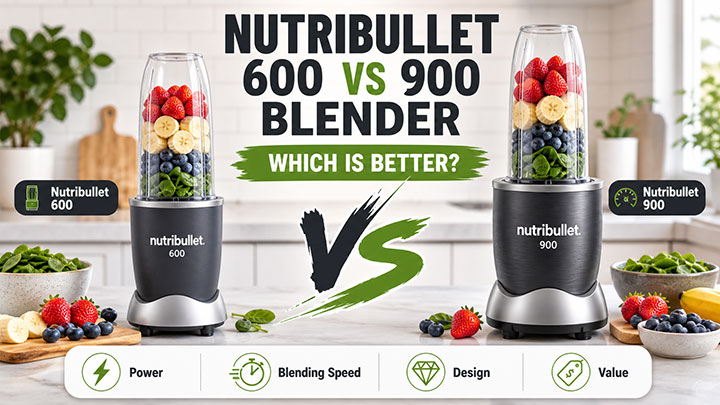
If you’re trying to decide between the nutribullet 600 vs 900 blender, you’re not alone. Many people struggle with this choice because both models look nearly identical but promise different performance for smoothies, shakes, and quick healthy drinks.
Common pain points include not knowing whether the extra wattage is really worth it, worrying about clutter, and wondering which one will last longer without breaking the bank.
In this detailed comparison, you’ll see exactly what sets the nutribullet 600 blender and nutribullet 900 blender apart, how they behave in real‑life use, and which model comes out on top for most home users. By the end, you’ll have a clear answer on which is better for your kitchen and lifestyle.
Side‑by‑side comparison table
| Feature | Nutribullet 600 Blender | Nutribullet 900 Blender | Winner |
|---|---|---|---|
| Price (US street, 2026) | Around $45–$65 (often on sale under $50) | Around $70–$100, frequent discounts near $75–$85 | Nutribullet 600 (better value) |
| Motor power | 600W motor, lower RPM (around ~20,000) | 900W motor, higher RPM (around ~25,000) | Nutribullet 900 (more powerful) |
| Build quality & materials | Plastic base, stainless‑steel extractor blade, BPA‑free cups; compact but basic | Same general build but slightly heavier base; feels a bit more solid overall | Nutribullet 900 (slightly better build) |
| Smoothie performance (fruit, protein, ice) | Good for soft fruits, yogurt, and light shakes; struggles a bit with very thick blends or tough ingredients | Smoother, more consistent results with frozen fruit, ice, and protein‑heavy mixes | Nutribullet 900 (better blend) |
| Controls | Simple twist‑on base; one‑speed on/off blending | Same twist‑on design; still one‑speed, but more torque at higher wattage | Nutribullet 900 (better control via power) |
| Cups & capacity | Two main cups (24 oz and 32 oz) plus lids and rings | Same cup set; 24 oz and 32 oz, often with extra rings or lids in some bundles | Tie (very similar) |
| Cleanup | Cups and lids are dishwasher‑safe; extractor blade is hand‑wash only | Same cleaning pattern; cups and lids dishwasher‑safe, blade must be hand‑washed | Tie |
| Noise level | Noticeably loud, typical of 600W personal blenders | Slightly stronger sound from the motor, but not drastically louder than the 600 | Nutribullet 600 (slightly quieter) |
| Warranty & durability | Standard limited warranty (about 1 year) | Same type of limited warranty; similar long‑term reliability profile | Tie |
| Portability (small kitchens, travel) | Very lightweight, compact footprint; easy to store in small spaces | Slightly heavier and bulkier base, but still countertop‑friendly | Nutribullet 600 (more portable) |
| Value for money | Excellent budget option; ideal if you want a simple personal blender | Higher price, but you pay for more power and smoother blends | Nutribullet 600 (best value) |
Detailed review of Nutribullet 600 Blender
What the Nutribullet 600 Blender is
The Nutribullet 600 Blender is the entry‑level model in Nutribullet’s lineup, yet it’s one of the most popular personal blenders for home users. It runs on a 600‑watt motor and spins at roughly 20,000 RPM, which is enough to shred most soft fruits, yogurt, and protein powder into drinkable smoothies. The standard set usually includes a 24‑oz and a 32‑oz cup, to‑go lids, sealing rings, and a stainless‑steel extractor blade, so you can blend, drink, and take your smoothie on the go without extra dishes.
Real‑world usage and performance
In everyday use, the Nutribullet 600 Blender shines for basic smoothies and light shakes. It handles bananas, berries, yogurt, and milk or milk alternatives very well, producing a smooth, drinkable texture with no big chunks under normal conditions. If you add ice, frozen fruit, or very thick nut‑butter mixes, the 600W motor can struggle a bit, requiring longer blending time or more liquid to keep the cups from overheating or stalling.
The twist‑on base is simple: you push the cup onto the motor, twist until it locks, hold the handle, and the blender spins as long as you keep it twisted. There are no speed settings or presets, which makes it easy to learn but also limits how much control you have over texture. This simplicity is great if you’re new to blenders or just want “set it and forget it” function.
Pros
- Very affordable price point, often under $50 on major retailers.
- Compact, lightweight base that fits small kitchens and crowded countertops.
- Two common cup sizes (24 oz and 32 oz) plus to‑go lids for easy blending and travel.
- Simple twist‑on operation requires almost no learning curve.
- Great for everyday smoothies, fruit‑based shakes, and light protein drinks.
Cons
- Only 600W of power, which is weaker when dealing with very thick ice, large amounts of frozen fruit, or dense nut‑butter blends.
- No speed or preset options; you control time manually, which can lead to over‑blending or under‑blending.
- Can be a bit noisy compared with higher‑end models.
- Leaves a slightly grainier texture with very fibrous greens or thick combinations.
For someone who wants a cheap, no‑fuss personal blender for basic smoothies and shakes, the Nutribullet 600 Blender is a strong, budget‑friendly choice. It’s not the most powerful or advanced option, but it covers the core needs for many casual users.
Detailed review of Nutribullet 900 Blender
What the Nutribullet 900 Blender is
The Nutribullet 900 Blender is the step‑up version of the 600 model, designed for people who want noticeably more power without switching to a full‑size counter blender. It features a 900‑watt motor and spins at about 25,000 RPM, which gives it a significant boost in torque and blending force.
The design is almost identical to the Nutribullet 600, with the same twist‑on base, 24‑oz and 32‑oz cups, and extractor‑blade layout, so it feels familiar if you’ve already used the 600.
Real‑world usage and performance
In real‑life use, the Nutribullet 900 Blender performs noticeably better with thicker blends. It handles frozen fruit, ice cubes, and protein‑heavy shakes with less effort, producing smoother, more consistent smoothies in a shorter time.
Leafy greens, seeds, and small amounts of oats blend more easily, and the 900W motor is less likely to stall or overheat when you push the ingredients a bit harder.
The basic twist‑on operation is the same: push the cup onto the base, twist it locked, and blend by holding the handle. There are still no speed settings or presets, but the added power means you can keep the blend shorter and still get a smoother result. This makes it ideal for people who want a bit more “oomph” without changing their workflow.
Pros
- 900W motor delivers stronger performance for smoothies, ice, and protein shakes.
- Smoother, more consistent texture with frozen fruit, seeds, and thicker bases.
- Same compact footprint and simple twist‑on design as the 600 model.
- Two standard cup sizes (24 oz and 32 oz) with to‑go lids for convenience.
- Great for more demanding recipes while still being a personal blender.
Cons
- Higher price tag, with the 900 typically selling for $70–$100.
- Still limited to one speed and no preset options, which can feel basic next to more advanced blenders.
- Not as quiet as some higher‑end personal blenders; the motor is stronger and louder.
- Similar cleaning routine to the 600, with the blade requiring hand‑washing.
If you want a noticeable upgrade from the Nutribullet 600 without jumping to a full‑size counter blender, the Nutribullet 900 Blender is a solid choice. It’s especially good if you often use frozen fruit, ice, or thicker smoothie bowls.
Final verdict & winner declaration
Between the Nutribullet 600 Blender vs Nutribullet 900 Blender, the clear winner for most people is the Nutribullet 900 Blender. It offers significantly more power, smoother blends, and better handling of frozen ingredients while keeping the same compact, user‑friendly design that made the Nutribullet line so popular.
The Nutribullet 900 Blender wins because it delivers better performance in real‑world use without asking you to completely change your routine. It handles thicker smoothies, icy drinks, and protein‑heavy mixes more confidently than the 600, which means you get closer to that “bar‑style” smoothie texture at home. For many users, that extra smoothness and power justify the slightly higher price, especially if you blend regularly and want results that feel more professional.
However, the Nutribullet 600 Blender still wins on value for money and simplicity. If you’re on a tight budget, live in a small space, or mainly drink basic smoothies and shakes, the 600 is more than enough and gives you decent performance for a much lower cost. It’s a great starter option or a second‑blender backup.
So, if you’re weighing “which is better” for everyday smoothies, the Nutribullet 900 Blender takes the top spot in terms of performance and future‑proofing, while the Nutribullet 600 Blender is the better choice if your main priority is saving money and keeping things simple. In most cases, the Nutribullet 900 Blender is the one that better justifies the upgrade in a head‑to‑head comparison.